
ASTRID2 – the ultimate synchrotron radiation source
Visit the accelerator laboratory ISA at the Department of Physics and Astronomy at the University of Aarhus, or look up in the night sky at the Crab Nebula, and you can see synchrotron light, where this light is created by electrons spiralling around magnetic fields and accelerated to almost the speed of light itself. In our laboratory, these conditions of space, harnessed on Earth, yield intense light which can be used as a powerful tool for a great diversity of sciences. In December 2008 ISA was awarded 37 Mkr from the National Programme for Research Infrastructure to build a state-of-the art synchrotron light source, ASTRID2, in Denmark for research within medicine, molecular and cell biology, nanotechnology and atomic and molecular physics. This source produces beams of remarkable quality, with tuneable wavelengths from the ultraviolet to the X-ray. The extraordinary brilliance of the light from ASTRID2 allows new science to be performed in which we examine drug action, probe new means of fabricating electronics and examine the properties of exotic metals, nanowires and biological molecules. ASTRID2 attracts large numbers of scientists from both Denmark and abroad, just as the previous source ASTRID did. ASTRID2 also has great educational potential, generating an exciting high tech environment for young people. Strong connections between Danish industry and the team constructing ASTRID2 were exploited to develop accelerators for cancer therapy, one of the great medical advances to come in the next decade.
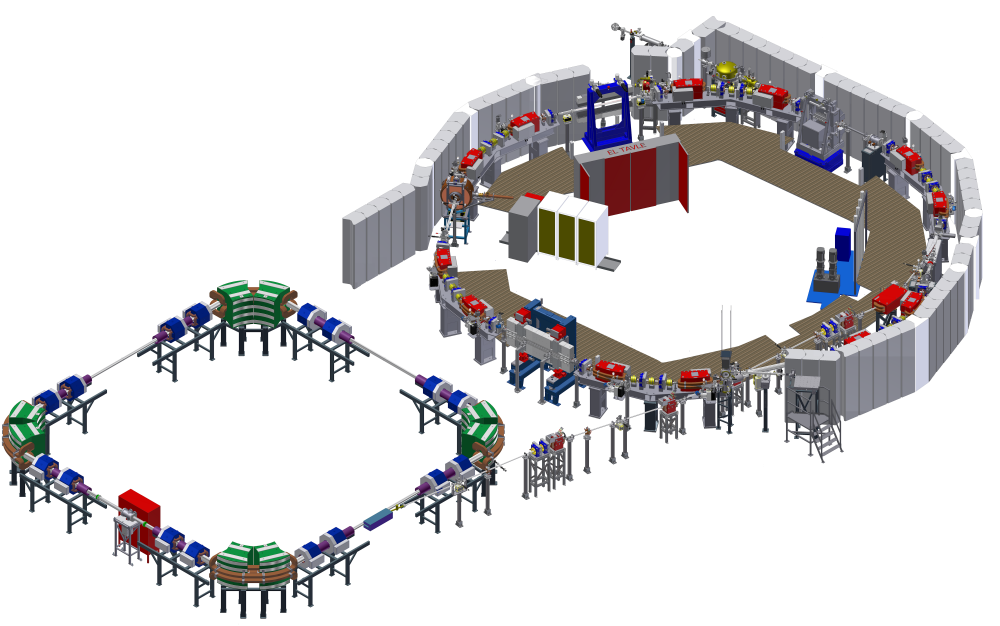 |
ASTRID2 with ASTRID on the left. The energy of the circulating electrons in ASTRID2 is 580 MeV, the horizontal emittance is 12 nm and the source is optimized to produce synchrotron radiation in the few eV to 1 keV energy range. Beam lifetime is effectively infinite using top-up of the electron current with ASTRID. The diameter of ASTRID2 is 15 m. |
The Scientific programme for ASTRID2
The scientific programme is divided into three areas biology, molecular physics and nanoscale and condensed matter. The programme heavily exploits the use of the so-called ‘wiggler and undulator insertion devices’, which yield two orders of magnitude brightness enhancement up to 1 keV and constitute a dramatic advance over ASTRID for studies of all types. The unique feature of the effectively infinite beam lifetime is vital to the success of numerous of the studies mentioned below and these could not be contemplated at other facilities, even if similar beamlines were to exist. Research will initially involve 150 scientists within more than 50 groups, expanding rapidly to 300 scientists from Denmark, Europe, the USA, China and Australia.
Technical Details
The storage ring ASTRID2 with a circumference of 45.7 m is sited in a purpose built hall, next to ASTRID. Laboratories for sample preparation are available next to the accelerator halls. ASTRID2 has a hexagonal structure with 4 straight sections for magnetic insertion devices, which enhance the brilliance of the radiation by two or more orders of magnitude. There are currently four beamlines from insertion devices on ASTRID2 together with three beamlines from bending magnets. ASTRID2 operates at 580 MeV and is optimised for photon energies from the visible to around 1 keV (1 nm). Parameters are shown in the table below, with those for ASTRID when operated as a SR source included for comparison. Today ASTRID is used as an injector for ASTRID2, accelerating 100 MeV electron beams from the microtron pre-injector, to 580 MeV, to allow full energy top-up of ASTRID2.
Parameter ASTRID2 ASTRID Energy (MeV) 580 580 Circumference (m) 45.7 40 Current (mA) 200 200 Lifetime (hours) Infinite (top-up) 50-100 Horizontal emittance (nm) 12 140 Characteristic energy (eV) 267 358 Characteristic wavelength (nm) 4.6 3.5 Straight sections (number and length) 4x2.8 1x2.0
Operating ASTRID2 at 580 MeV has the great advantage that frequent injections from ASTRID, invisible to the users, maintains an almost constant circulating current of 180 mA, in the so-called top-up mode. ASTRID2 is designed with combined-function magnets (dipole and quadrupole fields in the same magnet). This gives a very small emittance of 12 nm, which results in a beam size of less than 200×25 microns in the straight sections, leading to diffraction-limited synchrotron radiation.
The detailed design of ASTRID2 was finalized in September 2009.
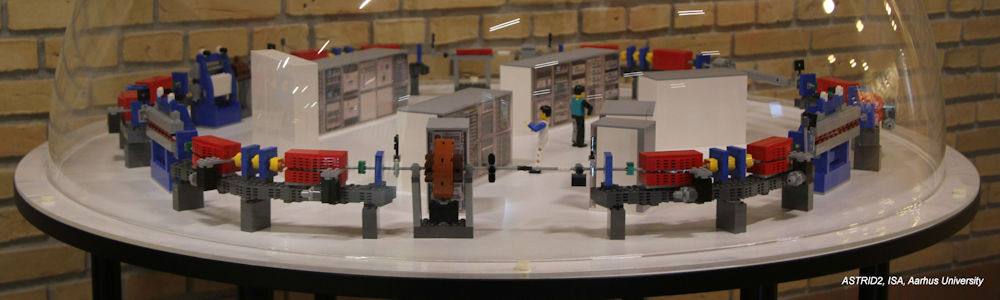
ASTRID2 Lego model |
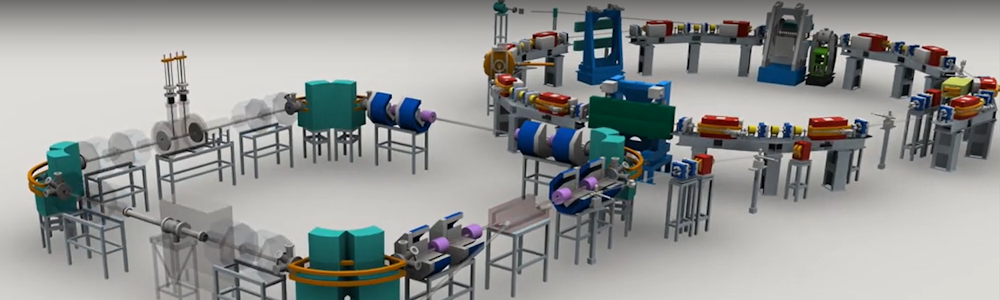
ASTRID2 Animation |
 |
 |
| Read more | Read more |
Last Modified 03 September 2024